Weekly

News about Lean, the theorem prover and programming language.

Published Nov 11, 2026

4 items.

AI and formalization

yang-mills-group posts OpenAI construction of pure Yang-Mills in Lean

The construction, obtained October 28, 2026, proves a challenge statement with a Mathlib-only import closure: for each closed matrix subgroup with nonabelian simple real Lie algebra, a Wilson lattice family with a Wightman reconstruction (positive energy, unique vacuum). A kernel replay found only standard axioms; a positive mass gap is outside the challenge's scope.

Checked against: yang-mills-group/OpenAI-YM-20261028
AI and formalization

Crowd-sourced project aims to make the 4D Yang-Mills Lean proof human-readable

The hairer/humanise-yang-mills repository plans a research monograph giving detailed proofs, traceable to a fixed version of the announced Lean formalisation of four-dimensional Yang-Mills theory, with contributors' agents working on tasks claimed through GitHub issues. Preliminary dependency mapping is under way; a full build, axiom audit, and line-by-line mathematical audit are still outstanding.

Checked against: hairer/humanise-yang-mills

AI and formalization

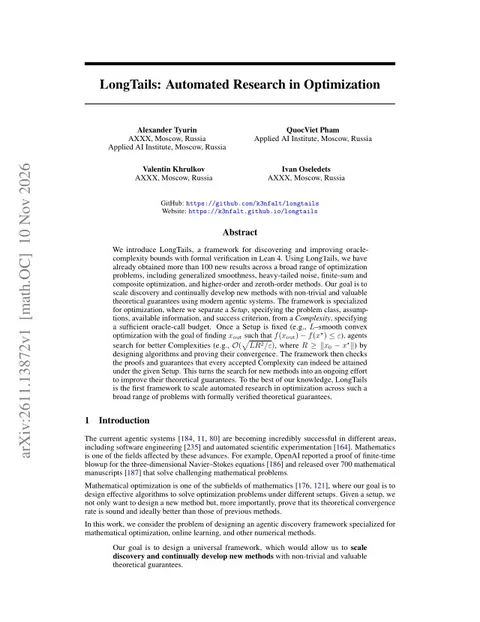
With LongTails, AI agents prove more than 100 new Lean-verified optimization bounds

In the Lean 4 framework by Alexander Tyurin, QuocViet Pham, Valentin Khrulkov, and Ivan Oseledets, agents such as Codex or Claude Code search for better oracle-call budgets under a fixed problem setup, and Comparator independently audits each result. One new gradient-only guarantee for (L0,L1)-smooth convex optimization resolves what the authors call an open problem.

First page of the paper
Image: paperswithlean.com

Checked against: arXiv:2611.13872k3nfalt/longtails

AI and formalization

Peter Burton formalizes a group whose nontrivial Bernoulli shifts are all isomorphic

The Palomar registry entry covers all standard probability bases whose measures are not point masses, with possibly different or infinite entropies. The countable group is built from the group of an OpenAI construction, which supplies the algebraic existence input; the formalization does not certify finitary or continuous conjugacy and says nothing about other groups.

Checked against: palomar-registry.orgpeterburton1728/bernoulli-iso-1