Weekly

News about Lean, the theorem prover and programming language.

Published Nov 17, 2026

10 items.

Verification

Lean harness ForShor verifies Shor's algorithm, including its asymptotic gate cost

Anirudh Suresh, Joshua M. Courtney, Runzhou Tao, and Yudong Cao prove correctness and gate-count theorems once for all valid policies (Toom-Cook multiplication designs, possibly from AI agents) and publish an open challenge at forshor.ai. At 2048 bits, a varying-arity policy gives about 1.685 trillion T-gates, against 1.820 trillion for the best single arity.
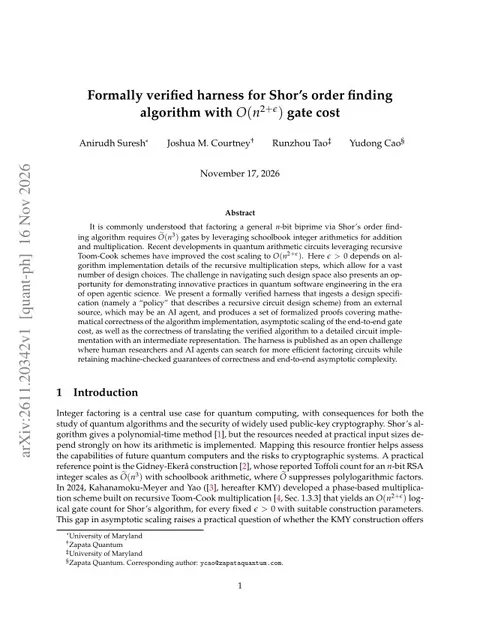
First page of the paper
Image: paperswithlean.com

Checked against: arXiv:2611.20342VerifiedQC/ForShorpaperswithlean.com
AI and formalization

One expert directing LLM agents ports CompCert's verified compiler core to Lean

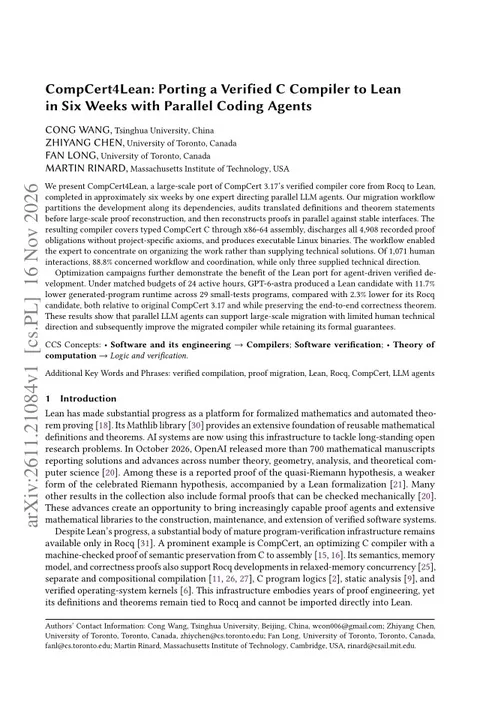
The port from Rocq took about six weeks, covers typed CompCert C through x86-64 assembly, and discharges all 4,908 proof obligations without project-specific axioms; 88.8% of 1,071 human interactions concerned workflow and coordination. With 24 active hours, GPT-6-astra cut generated-program runtime by 11.7% in Lean versus 2.3% in Rocq, preserving the end-to-end correctness theorem.

First page of the paper
Image: paperswithlean.com

Checked against: arXiv:2611.21084fanlong/compcert4leanpaperswithlean.com

Verification

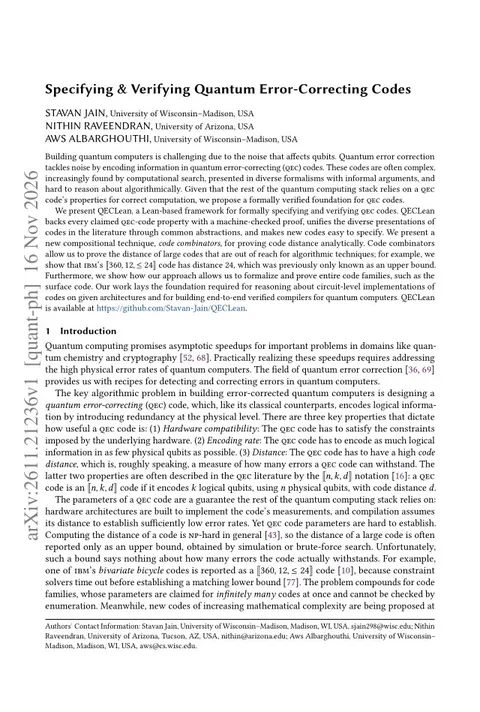
QECLean, a Lean framework, proves an IBM quantum code has distance 24

Stavan Jain, Nithin Raveendran and Aws Albarghouthi's framework, built on Mathlib, backs every claimed property of quantum error-correcting codes with a machine-checked proof. Its new code combinators prove distance compositionally for large codes beyond algorithmic techniques (24 was previously only an upper bound), and it formalizes entire code families such as the surface code.

First page of the paper
Image: paperswithlean.com

Checked against: arXiv:2611.21236QECLean/QECLean

AI and formalization

Joris Roos formalizes Carleson's theorem on Fourier series using coding agents

The Lean 4 formalization proves bounds for the triangular Hilbert transform, following a streamlined version of an OpenAI manuscript; the bounds also give an alternative proof of Carleson's theorem. Theorem statements are human-written, while the proof was automatically generated by Codex/GPT-6 Astra Light and Medium, plus Claude Code Opus 5.5 Medium.

Checked against: palomar-registry.orgroos-j/lean-triangular

AI and formalization

AxiomMath formalizes the minimal model program in dimension at most four

AI agents wrote the library, about 2,270 modules built on Mathlib and the Stacks Project in Lean; its four-dimensional theorem follows a 2026 OpenAI paper on termination for log canonical fourfolds. Lean's kernel checks every proof, with no sorry, no native_decide and no added axiom, though humans have not yet reviewed the code.

Checked against: AxiomMath/MMP

AI and formalization

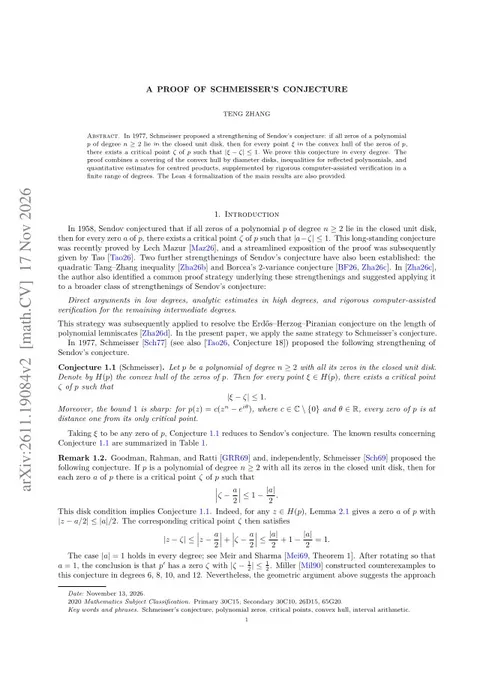
Teng Zhang proves Schmeisser's 1977 conjecture; OpenAI's Codex formalizes it in Lean

The conjecture strengthens Sendov's: if a polynomial's zeros lie in the closed unit disk, every point of their convex hull is within distance 1 of some critical point. The Mathlib-based formalization covers every degree with no sorry placeholders or extra axioms, and Lean's kernel checks its interval certificates for degrees 4 to 6,000.

Image: paperswithlean.com

Checked against: paperswithlean.comzhangteng2000/schmeisser-conjecture

AI and formalization

Hassana Labs defines EleutherAI's Pythia-14M exactly over the reals in Lean 4

The tiny-bayes repository decodes all 14,067,712 parameters exactly from float16 bit patterns and defines the GPT-NeoX forward pass using exact GELU, with kernel-certified outputs. Theorems depending only on the axioms propext, Classical.choice and Quot.sound show that a tiny transformer's Bayesian-in-expectation result (order averages within 0.0034 of Laplace's rule) does not extend to Pythia-14M.

Checked against: leochlon/tiny-bayes

AI and formalization

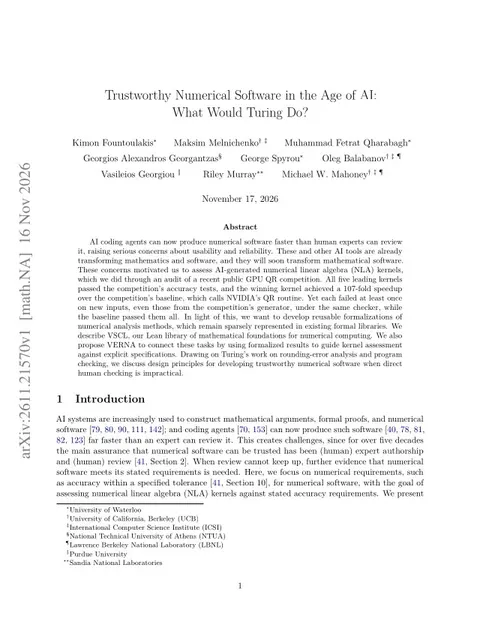
Kimon Fountoulakis and coauthors describe VSCL, a Lean library formalizing numerical analysis

To assess AI-generated kernels, the authors audited a GPU MODE QR competition: all five leading kernels passed its accuracy tests, yet each failed at least once on new inputs under the same checker, while the baseline passed them all. The authors propose VERNA, which would use formalized results to test kernels against explicit specifications.

First page of the paper
Image: paperswithlean.com

Checked against: arXiv:2611.21570the-numerical-proving-ground/gpumode-kernel-audit-2026paperswithlean.com

Verification

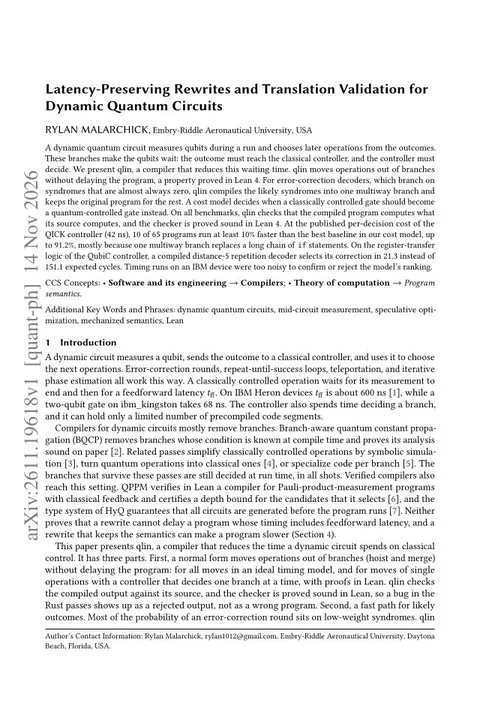
Rylan Malarchick presents qlin, a dynamic quantum circuit compiler with Lean proofs

Lean 4 proofs show that qlin moves operations out of measurement-dependent branches without delaying the program, and that its check of each compiled program against its source is sound. Modeled at the QICK controller's 42 ns per decision, 10 of 65 programs run at least 10% faster than the best baseline, up to 91.2%.

First page of the paper
Image: paperswithlean.com

Checked against: arXiv:2611.19618rylanmalarchick/qlin

Verification

TrustBound proves in Lean how to account for payments outliving AI agents

Sandip Nandi, Aishwarya Bose, Apurba Bose and Soovadeep Bakshi prove that once a fence stops new admissions, discharging outstanding rights prevents further payments, and that truthful outcomes give exact accounting. Lean accepts six histories from a Python/SQLite service; concurrent tests exposed a conflict from reordered provider reads, fixed in all 84 tested cases.

First page of the paper
Image: paperswithlean.com

Checked against: arXiv:2611.19551tokencraftdata/trustboundpaperswithlean.com