Weekly

News about Lean, the theorem prover and programming language.

Published Nov 21, 2026

12 items.

AI and formalization

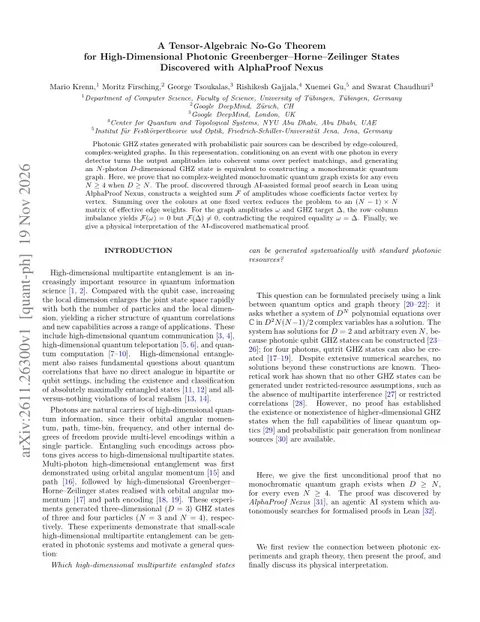
AlphaProof Nexus finds Lean proof of high-dimensional photonic GHZ no-go theorem

Mario Krenn and coauthors used AlphaProof Nexus, which combines language models with Lean compiler feedback, to prove a Formal Conjectures statement: no complex-weighted monochromatic quantum graph exists for any even N of at least 4 when D is at least N. Generating an N-photon, D-dimensional GHZ state is equivalent to constructing such a graph.
First page of the paper
Image: paperswithlean.com

Checked against: arXiv:2611.26300paperswithlean.com

AI and formalization

Levent Alpöge releases a Lean proof of the Riemann Hypothesis

Levent Alpöge, working with Claude, released the proof on November 20, 2026, as a Lean library comprising 17 million lines of code; an unmodified mirror is on GitHub. The Lean and Mathlib communities certified both the statement and the proof as correct after several proof checkers, including Lean's official kernel, checked the exported proof.

Image: leanprover-community.github.io

Checked against: leanprover-community.github.ioCocoSgt/riemann-hypothesis-lean

Lean core

Joachim Breitner removes large elimination for recursive Prop inductives from Lean's kernel

The merged pull request, part of the Lean Kernel Renovation, restricts recursors such as Acc.rec to motives in Prop, while Eq and And keep large elimination. The goal is a kernel that never has to look at a proof term, which would let tools like external checkers drop proof subterms after typechecking.

Checked against: lean4#13851

Verification

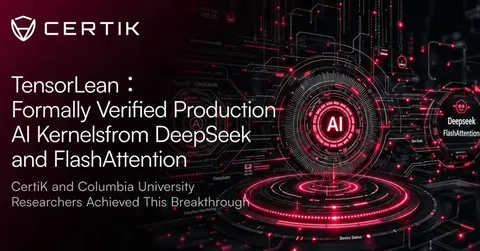
CertiK and Columbia University researchers formally verify GPU kernels in Lean

Using TensorLean, which checks compiled PTX code, the researchers proved 83 of 149 kernel instances conform to their Lean specifications, in what CertiK calls the world's first formal verification of production-grade AI operators. The team found 38 correctness issues across 6 libraries, including 2 in DeepSeek's DeepGEMM and 23 in the FlashAttention operator library.

CertiK and Columbia University Researchers Release TensorLean Results, Completing the World's First Formal Verification of Production-Grade AI Operators in DeepSeek and FlashAttention
Image: panewslab.com

Checked against: panewslab.com

AI and formalization

Dana S. Scott and coauthors formalize domain theory papers in Lean 4

Lars Warren Ericson, Dana S. Scott, Vijay D'Silva, and Brian Milnes wrote Carnegie Mellon report CMU-CS-26-138, a machine-checked Lean 4 formalization of Dana Scott's papers on domain theory: continuous lattices (1972), datatypes as lattices (1976), neighbourhood systems (1980), and information systems (1982). It adds bridge theorems relating the lattice, neighbourhood, and information systems presentations.

Checked against: paper (pdf)

AI and formalization

Jz Pan and contributors formalize Iwasawa's classical class-number growth theorem

The theorem describes how the p-adic multiplicity of class numbers grows along an increasing tower of finite cyclic Galois extensions of a number field. The Lean statement uses only Mathlib concepts, and the proof relies on Naganori Yamaguchi's external Nyll class field theory library for the Hilbert class field inputs.

Checked against: palomar-registry.orgacmepjz/lean-iwasawa

AI and formalization

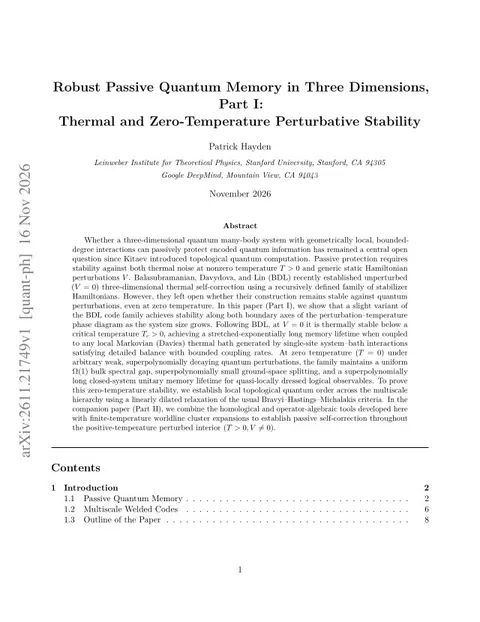
Patrick Hayden machine-checks 3D passive quantum memory theorems in Lean

Whether 3D quantum systems with local interactions can passively protect quantum information has been open since Kitaev introduced topological quantum computation. Patrick Hayden's two-part paper shows a variant of Balasubramanian, Davydova, and Lin's code family resists thermal noise and weak quantum perturbations; Lean proofs of existential theorems for both parts have zero sorry placeholders.

First page of the paper
Image: paperswithlean.com

Checked against: pmhayden/passive-quantum-memoryarXiv:2611.21749

Verification

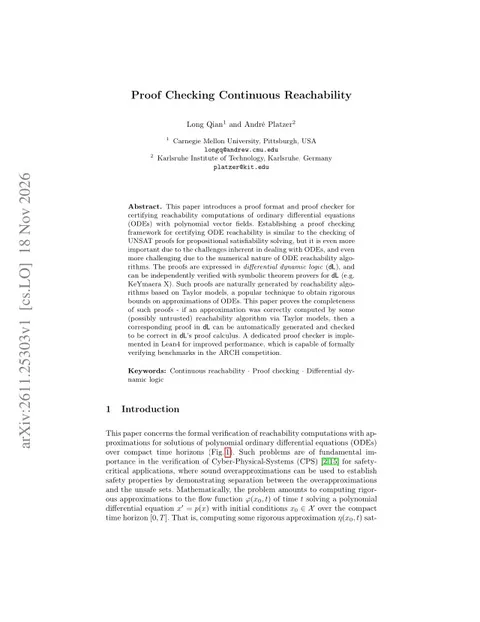
Long Qian and André Platzer check ODE reachability proofs with Lean 4

The paper's differential dynamic logic proofs certify ordinary differential equation (ODE) reachability, like UNSAT proofs in satisfiability solving, and any approximation correctly computed via Taylor models (a technique for rigorous ODE bounds), even by untrusted algorithms, provably yields one. The checker, implemented in Lean 4 for improved performance, can formally verify ARCH competition benchmarks.

First page of the paper
Image: paperswithlean.com

Checked against: arXiv:2611.25303

Verification

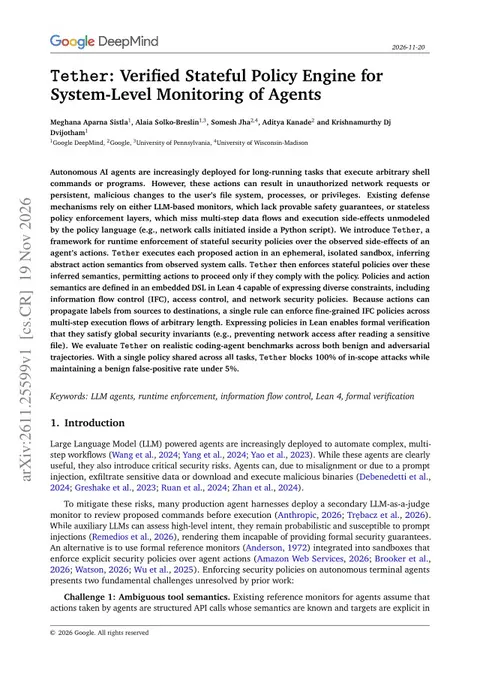
Tether monitors AI agents with security policies written in Lean 4

Tether, by Meghana Aparna Sistla and coauthors, sandboxes proposed commands and commits side effects only if a policy allows them; its Lean 4 DSL is both the executable monitor and the specification for mechanized proofs. On coding-agent benchmarks, one shared policy blocks 100% of in-scope attacks with a 4.7% benign false-positive rate.

First page of the paper
Image: paperswithlean.com

Checked against: arXiv:2611.25599paperswithlean.com

Verification

@rasidency publishes heresy, a Fil-C to Haskell compiler with Lean-checked output

The compiler itself is written in OCaml; for accepted programs, Lean proves that the source and lowered models agree on completed observations, including exit status and stdout. A separate native backend emits a 132-byte x86-64 Linux executable for a closed integer expression and proves its exit status in the machine model.

Checked against: rasidency/heresy

Papers and events

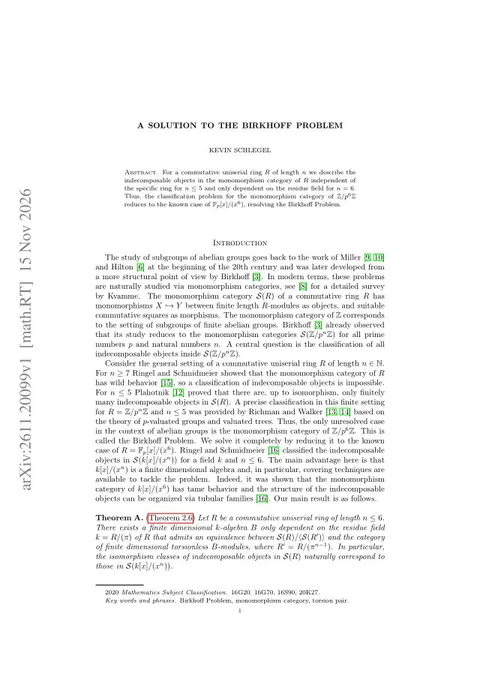
Kevin Schlegel posts a solution to the Birkhoff Problem on arXiv

For a commutative uniserial ring, the paper describes the indecomposable objects in its monomorphism category, independently of the specific ring for lengths up to 5 and depending only on the residue field for length 6. Classifying the monomorphism category of the integers modulo p⁶ thus reduces to a known case, resolving the Birkhoff Problem.

First page of the paper
Image: paperswithlean.com

Checked against: arXiv:2611.20099

Papers and events

Cheshire Cat (@y-taka-23) posts Lean code for a book on compiler proofs

The lean-verified-compiler repository holds the sample code for 『コンパイラ証明技法』 (Compiler Proof Techniques), a self-published book on implementing a Wasm compiler in Lean, distributed at 技術書典 21. The README's steps run lake build and lake exe, convert out/julia.wat with wat2wasm, and open a locally served page in a browser.

Checked against: y-taka-23/lean-verified-compiler