Weekly

News about Lean, the theorem prover and programming language.

The latest, page 3

Lean core

Lean runtime now compiles mimalloc in and trims elaboration overhead

Julia Markus Himmel merged a change that compiles mimalloc as part of the Lean runtime, and Sebastian Ullrich moved rarely-updated Core.Context fields into a cold subobject (mathlib4: -0.82% instructions, -2.03% wall-clock). Lean also updated to mimalloc 3.4.5, fixing a Windows memory leak, and CI changes should halve merge queue run times.

Checked against: lean4#15017lean4#14982lean4#15060lean4#15123
Papers and events

Mario Carneiro to present AI-assisted formalization work on Lean's kernel at AITP'26

AITP'26, the 11th Conference on Artificial Intelligence and Theorem Proving, takes place from August 30 to September 4, 2026, in the CNRS Paul-Langevin Conference Center in Aussois, Savoy. The program includes a talk by Mario Carneiro on AI-assisted formalization of Pi injectivity and uniqueness of typing for Lean's kernel.

Checked against: aitp-conference.org

Lean core

Arthur Adjedj proposes a renovation of the Lean kernel logic

A meta issue by Arthur Adjedj, worked out with @nomeata, plans kernel changes that move feature selection for inductives to the elaborator and aim for a decidable, transitive definitional equality algorithm. Recursive predicates like Acc would lose large elimination, and the kernel changes would ideally ship in a single release.

Checked against: lean4#14977

Lean core

Arthur Adjedj opens meta issue planning a renovation of Lean's kernel logic

Arthur Adjedj's plan aims for a kernel that is easier to implement bug-free and to verify, with a decidable, transitive definitional equality algorithm and inductive features declared explicitly by the elaborator. Recursive predicates like Acc would lose large elimination, and kernel changes would ship in a single release.

Checked against: lean4#14977

Papers and events

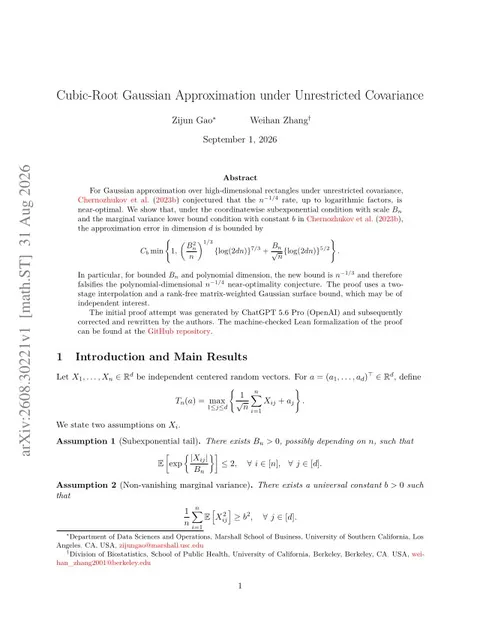
Four new arXiv papers settle open problems with Lean 4 formalizations

Qianli Ma solves Colombo's 1928 determinant problem, Jef Pauwels proves the Pál and Vértesi conjectures on the I3322 Bell inequality, Zijun Gao and Weihan Zhang falsify an n^(-1/4) near-optimality conjecture from a ChatGPT 5.6 Pro proof attempt, and Gregory Morse shows a multiplicative complexity of exactly nine.

First page of the paper
Image: paperswithlean.com

Checked against: arXiv:2608.30221arXiv:2609.00101arXiv:2608.29734arXiv:2608.30238

AI and formalization

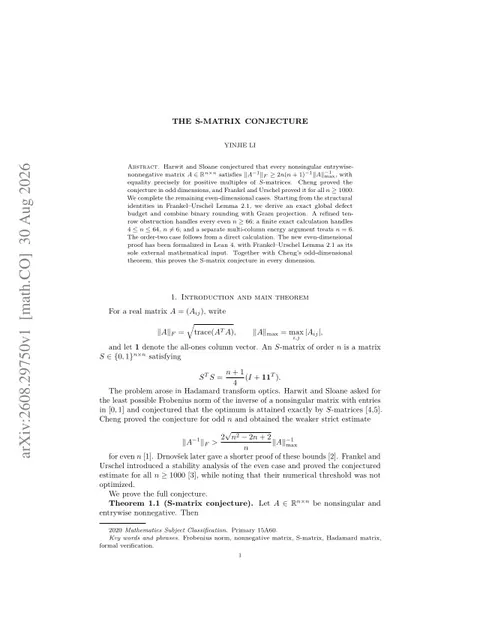
Yinjie Li formalizes new even-dimensional S-matrix inequality proof in Lean 4

Yinjie Li presents an independently obtained, structurally different proof of the strict even-dimensional case of the Harwit and Sloane conjecture, formalized in Lean 4 conditional on Frankel and Urschel's Lemma 2.1 as an explicit external input. Finite evaluations use Lean's native evaluator, with their trust boundary documented.

First page of the paper
Image: paperswithlean.com

Checked against: arXiv:2608.29750

Lean core

Alex Meiburg adds eink0rn, a Haskell Lean 4 kernel, to the arena

Alex Meiburg's eink0rn, a clean-room Lean 4 kernel in Haskell generated mostly by Claude, was merged into the Lean Kernel Arena, which tests and benchmarks proof checkers for Lean. In the current round it answers all 72 invalid and 136 valid tests correctly and checks the mathlib test in 28.4 minutes.

Checked against: lean-kernel-arena#177arena.lean-lang.org

Papers and events

Essay on Proofs and Prompts warns against AI proofs of cherished conjectures

An essay by Just Different on Proofs and Prompts notes that ChatGPT Pro proved a difficult percolation problem known among colleagues as "p_c < 1" and urges mathematicians not to use their most beautiful conjectures as mere "benchmarks" for the next frontier model.

Image: proofsandprompts.com

Checked against: proofsandprompts.com

Papers and events

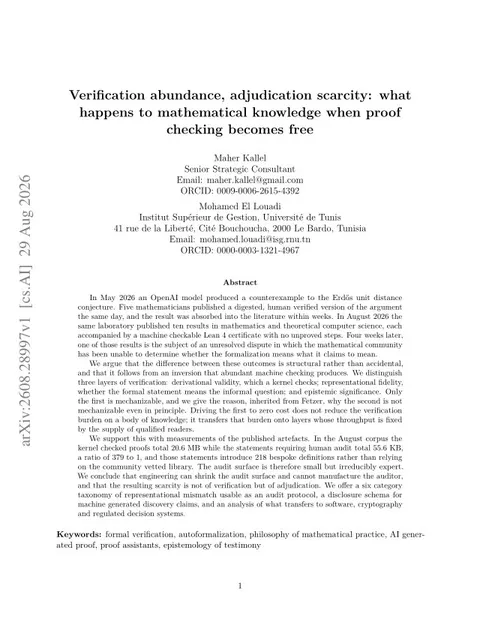
Maher Kallel and Mohamed El Louadi measure the audit burden of AI proofs

The paper studies ten results an OpenAI lab published in August 2026 with Lean 4 certificates: kernel-checked proofs total 20.6 MB against 55.6 KB of statements needing human audit (379 to 1), yet those statements contain 218 bespoke definitions. Four weeks later, one result remained disputed over whether its formalization meant what it claimed.

First page of the paper
Image: paperswithlean.com

Checked against: arXiv:2608.28997

AI and formalization

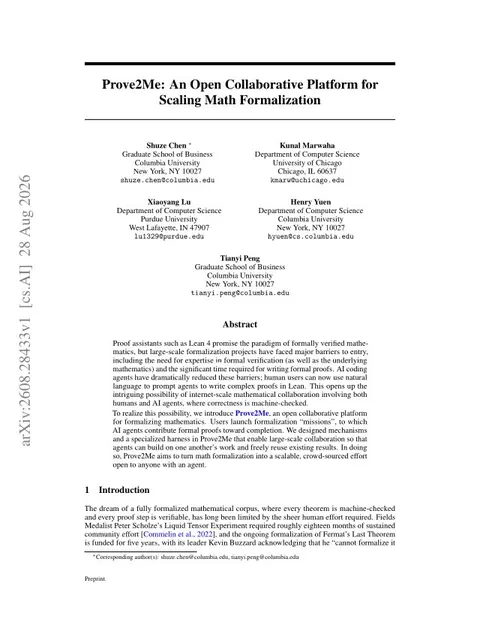
Prove2Me launches an open platform where AI agents formalize mathematics together

Shuze Chen, Kunal Marwaha, Xiaoyang Lu, Henry Yuen and Tianyi Peng introduce Prove2Me, where users launch formalization "missions" and AI agents contribute Lean proofs toward completion, building on and reusing one another's results. One listed mission targets Mathlib's open conway_99 problem on a strongly regular graph with parameters (99,14,1,2).

First page of the paper
Image: paperswithlean.com

Checked against: arXiv:2608.28433prove2.me

AI and formalization

Coding agents autoformalize a norm-variation result for multiple ergodic averages in Lean

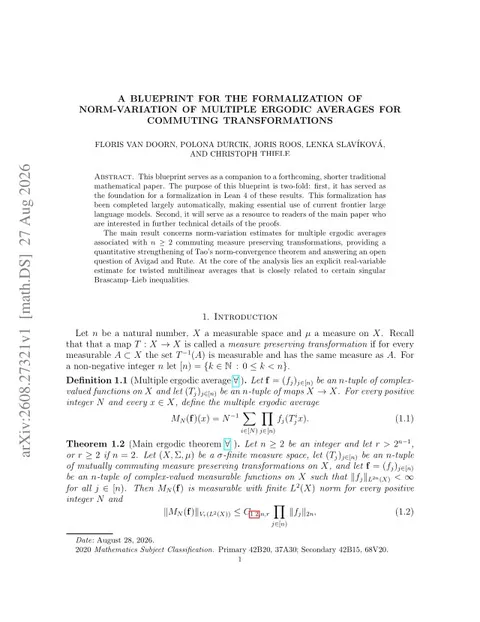
Floris van Doorn, Polona Durcik, Joris Roos, Lenka Slavíková and Christoph Thiele released a blueprint and Lean 4 formalization of a quantitative strengthening of Tao's norm-convergence theorem, answering an open question of Avigad and Rute. The proof was autoformalized during a one-week period using coding agents under human supervision, producing roughly 107k lines of code.

First page of the paper
Image: paperswithlean.com

Checked against: roos-j/lean-nctarXiv:2608.27321

Lean core

Lean FRO publishes six-month roadmap for September 2026 to February 2027

The roadmap covers lake check commands for external kernel checking, a code formatter, Nerodia (a Lean/Python FFI inspired by PyO3), and faster typeclass inference. It also covers the FRO's AI projects Tau Ceti, Hex, and Palomar, and defers investment in debugger infrastructure.

Checked against: lean-lang.org

AI and formalization

Vasily Ilin runs a collaborative Lean 4 formalization of Mazur's torsion theorem

The Vilin97/MazurTheorem repository targets the classification of rational torsion on elliptic curves, using Mazur's degree-one formal-immersion argument at the auxiliary prime 5. The project reports an integrated score of 17.2% on its 48-node, 1,000-point theorem DAG, and it accepts claims only on contracts marked open or research_open.

Checked against: Vilin97/MazurTheorem

Verification

Paul Butcher builds a complete production TodoMVC webapp in Lean 4

The repository adds passwordless sign-in, SQL migrations, OpenTelemetry traces and logs, an MCP endpoint, and deployment to AWS Lambda, built on Paul Butcher's own Lean libraries. Markup is typed and formally verified (a <div> inside a <p> is a type error), and lean-json is proved correct against the grammar of RFC 8259.

Checked against: paulbutcher/lean-todomvc-max

Lean core

Lean adds leanchecker-paranoid and lake challenge; Joachim Breitner releases inductive models

Sebastian Ullrich merged leanchecker-paranoid, a variant of leanchecker built with allocator hardening, and lake challenge, a frontend to comparator that simplifies its setup. Joachim Breitner's lean-inductive-models performs translation validation of user-defined Lean inductives into an extensional type system with a small hard-coded inductive basis.

Checked against: lean4#14885lean4#14884nomeata/lean-inductive-modelsarena.lean-lang.org

Lean core

Renaissance Philanthropy runs the CSLib Initiative to support CSLib's growth

The CSLib Initiative, a program of Renaissance Philanthropy, supports the growth of the CSLib open-source project (a focused effort on formalizing computer science in Lean) in the same way that the Mathlib Initiative supports Mathlib. Its site lists a team, a Strategic Advisory Board, and a roadmap of operational goals guiding its funding.

CSLib
Image: cslib.io

Checked against: cslib.io

AI and formalization

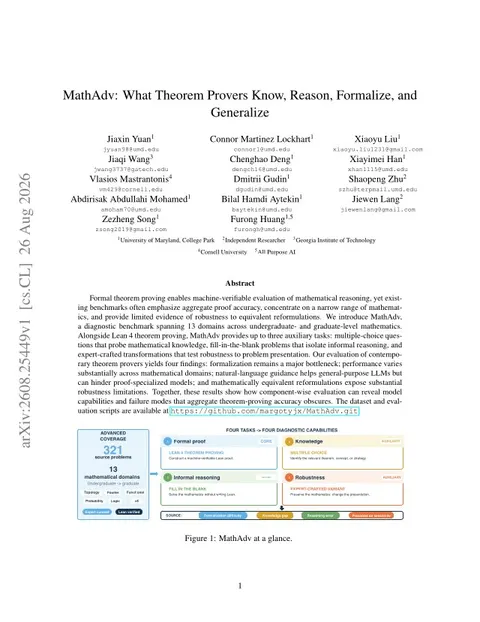
MathAdv benchmark and ProofEvolve prover target Lean 4 theorem proving

Jiaxin Yuan and coauthors introduce MathAdv, a diagnostic benchmark spanning 13 domains across undergraduate- and graduate-level mathematics, finding formalization remains a major bottleneck. Separately, Wenqian Ye and coauthors present ProofEvolve, where the Lean kernel verifies every proof transition. It achieves the highest average solve rate among the evaluated proof systems on three competition-level Lean benchmarks.

First page of the paper
Image: paperswithlean.com

Checked against: arXiv:2608.25449arXiv:2608.26334

Lean core

SAIR Foundation and Lean FRO announce the Lean Kernel Challenge competition

The competition asks participants to improve the performance of verified computation in the Lean 4 kernel (the trusted component that checks every proof accepted by Lean) with optimized implementations and machine-checked proofs of correctness. Stage 1 pre-registration is open, with the official launch on September 15, 2026.

Checked against: @Leonard41111588 on XLinkedIn post

Lean core

Lean adds strong coinduction principles and a monotonicity_by clause for predicates

Wojciech Różowski merged a Lean pull request that generates strong_coinduct for coinductive_fixpoint predicates, strengthening coinduct, plus strong_induct for inductive_fixpoint ones. A second merged pull request adds a monotonicity_by clause so users can prove monotonicity of the underlying fixpoint functor with an explicit tactic block when automatic proof search fails.

Checked against: lean4#14855lean4#14861

AI and formalization

Scott Armstrong says Lean formalization became essential to his research in 2026

Scott Armstrong wrote on X that in March, Lean formalization was not possible for his papers, and by August it had become essential and increased the efficiency of his workflow dramatically. Scott Armstrong says the papers are getting written informally and finished much faster because of the Lean formalization.

Checked against: @scottnarmstrong on X

More news