Weekly

News about Lean, the theorem prover and programming language.

The latest, page 9

Lean core

Leo de Moura merges Sym framework and transparency changes into Lean

Leo de Moura merged pull requests adding Sym.Arith infrastructure for arithmetic normalization, fixing the sym canonicalizer, and adding a backward.isDefEq.respectTransparency.types option. An opt-in linter also warns about rfl simp theorems that only hold at higher transparency, part of a broader effort to ensure isDefEq respects transparency levels.

Checked against: lean4#13289lean4#13317lean4#13280lean4#13271lean4#13272lean4#13273lean4#13281

Lean core

Leo de Moura proposes stricter transparency default for Lean's definitional equality checker

Leo de Moura opened a pull request enabling the backward.isDefEq.respectTransparency.types option by default, so the definitional equality checker respects the current transparency setting when matching metavariable types. The change prevents unintended unfolding of definitions and requires adding @[implicit_reducible] and @[expose] attributes to many library definitions.

Checked against: lean4#13283

Papers and events

Leo de Moura explains in a blog post why Lean works

In "Why Lean?", dated 2026-04-02, Leo de Moura argues that implementing Lean in Lean lets users extend it freely, and points to a small trusted kernel with multiple independent implementations. The post also names backward compatibility as Lean's weakness: Lean code written two years ago probably needs changes to compile today.

Checked against: leodemoura.github.io

Lean core

leanprover-community releases a tool for offline Lean 4 teaching bundles

The bundle tool creates self-contained Lean 4 bundles for teaching: students download a zip, unpack it, double-click "Start_Lean", and get a working editor with no installation, no network access, and no command line needed. Each bundle ships VSCodium with the lean4 extension and only the oleans the project needs.

Checked against: leanprover-community/bundle

Papers and events

Leo de Moura publishes blog post "Why Lean?"

In a post dated 2026-04-02, Leo de Moura argues that Lean's implementation in Lean itself underpins its extensibility, scalability, and soundness through a small trusted kernel. The post also names backward compatibility as Lean's weakness: code written two years ago probably does not compile today without changes.

Checked against: leodemoura.github.io

Papers and events

Leo de Moura presents Lean talk at the University of Minnesota

Leo de Moura (AWS, Lean FRO) gave the talk "Lean: Machine-Checked Mathematics and Verified Programming" on March 30, 2026. The slides describe a general-purpose AI converting zlib (a C compression library) to Lean and proving the code correct, plus grind, a proof-automation tactic inspired by modern SMT solvers.

Checked against: leodemoura.github.io
Lean core

Lean 4.29.0 released with a new extensible do elaborator

The release changes reducibility handling: isDefEq no longer bumps transparency when comparing implicit arguments, and a new @[implicit_reducible] attribute and a backward-compatibility option ease migration. It also adds grind support for higher-order Miller patterns, mvcgen support for specifications in the local context, and faster startup.

Checked against: v4.29.0 release noteslean4 v4.29.0

Verification

Bas Spitters releases CatCrypt, machine-checked cryptographic security proofs in Lean

CatCrypt provides a pipeline from Rust reference implementations, translated with the Hax tool, to security proofs in Lean, covering 172 cryptographic protocols and constructions (110 with the full Rust-to-Lean pipeline). Bas Spitters developed the whole library in two months working with GenAI.

Checked against: eprint.iacr.org

Papers and events

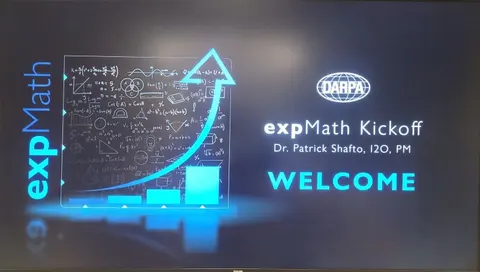
DARPA held the kickoff meeting for its Exponentiating Mathematics (expMath) program

Patrick Shafto reported that the DARPA expMath kickoff included teams from CMU, Stanford, MIT, UCLA, Princeton and other universities, plus a panel of community supporters including Leo de Moura and the Lean FRO community, and Adam Topaz and the Mathlib Initiative.

Image: linkedin.com

Checked against: LinkedIn post

Papers and events

Blog post argues Lean 4 is the greatest theorem prover

In "Lean 4 is the Greatest to Ever Do It", the author implements a small garbled-circuit evaluator using point-and-permute in Lean. The project combines a macro-based circuit syntax, OpenSSL bindings through Lean's C interface, imperative-style code, and a proof that the serializer behaves properly.

Checked against: markusde.ca

Papers and events

Leo de Moura presents Lean 4 at NASA Formal Methods Symposium

Leo de Moura, Chief Architect of the Lean FRO, presents "Lean 4: A Unified Platform for Programming and Verification" at the NASA Formal Methods Symposium on May 6, 2026. The talk covers grind, Lean's new proof automation, and industry verification work including Cedar, SampCert, and SymCrypt.

Checked against: leodemoura.github.io
Papers and events

Leo de Moura surveys industrial and AI uses of Lean at ETAPS 2026

Leo de Moura gave an ETAPS tutorial on April 13, 2026, then an ETAPS Industry Day talk on April 15 covering Cedar (access control), SampCert (privacy), Strata (languages), Waimea (compiler), SymCrypt (crypto), Anneal (unsafe Rust) and Veil (distributed protocols), plus AI provers for which Lean is the training environment, evaluation harness, and deployment target.

Checked against: leodemoura.github.io

AI and formalization

Mistral AI releases Leanstral, an open-source code agent for Lean 4

Mistral AI released Leanstral, with 6B active parameters and weights under an Apache 2.0 license. On FLTEval, a new suite built from pull requests to the FLT project, Leanstral pass@2 scores 26.3, beating Sonnet by 2.6 points while costing $36 to run versus Sonnet's $549.

Image: mistral.ai

Checked against: mistral.ai

Papers and events

Leo de Moura explains how independent kernels protect Lean from prover bugs

In the blog post "Who Watches the Provers?", Leo de Moura notes that Claude (Opus 4.6) found seven kernel bugs in Rocq and two in Nanoda, a Lean proof checker written in Rust, but no proof of false in Lean's official kernel. The Lean Kernel Arena tests 7 kernels against 133 benchmarks.

Checked against: leodemoura.github.io
Papers and events

Menlo Ventures leads Axiom's $200 million Series A for Verified AI

Menlo Ventures announced it is leading a $200 million Series A for Axiom at a $1.6 billion post-money valuation. Axiom trains systems to produce formally verified outputs in Lean, and Menlo Ventures describes the bet as one that Verified AI is a new paradigm.

Image: menlovc.com

Checked against: menlovc.com

Papers and events

Axiom raises $200 million to verify AI-generated code with Lean

Axiom Quant's Series A round, led by Menlo Ventures, values the startup at $1.6 billion. Axiom trains AI systems to generate formally verified outputs in Lean and plans to scale its training infrastructure and expand its team of math experts.

Image: siliconangle.com

Checked against: siliconangle.com

Lean core

Henrik Böving ports Lean's C emission pass from IR to LCNF

A merged pull request by Henrik Böving ports the C emission pass from IR to LCNF. The PR describes this as the last step of the IR/LCNF conversion, enabling end-to-end code generation through the new compilation infrastructure.

Checked against: lean4#12781

AI and formalization

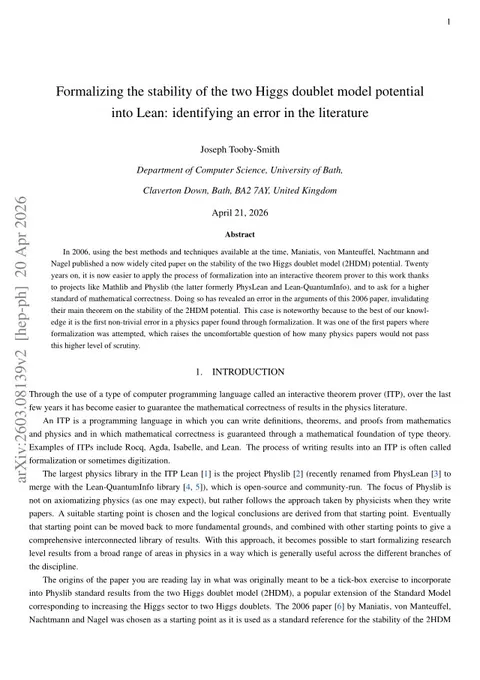
Joseph Tooby-Smith's Lean formalization finds error in widely cited 2006 physics paper

Formalizing a 2006 paper on the stability of the two Higgs doublet model (2HDM) potential, using Mathlib and Physlib, revealed an error invalidating its main theorem. The paper calls this, to the best of its knowledge, the first non-trivial error in a physics paper found through formalization.

First page of the paper
Image: paperswithlean.com

Checked against: arXiv:2603.08139

AI and formalization

Math, Inc.'s Gauss completes formal proof of sphere packing in dimensions 8 and 24

Math, Inc. used Gauss to help formally verify Maryna Viazovska's Fields Medal-winning sphere packing results, proving all remaining 8-dimensional results in 5 days and autoformalizing the 24-dimensional case in two weeks. The formalization grew from 70k to about 200k lines.

Image: math.inc

Checked against: math.inc

More news