Weekly

News about Lean, the theorem prover and programming language.

The latest, page 2

Papers and events

Paper ports Iris, a concurrent separation logic framework, to Lean

Markus de Medeiros, Ralf Jung, Lars Birkedal and nine coauthors explore how Lean features like flexible metaprogramming and quotient types can simplify the design and usage of Iris, providing a new implementation of the Iris proof mode with improved performance. Integration with Mathlib supports an application to probabilistic program verification.
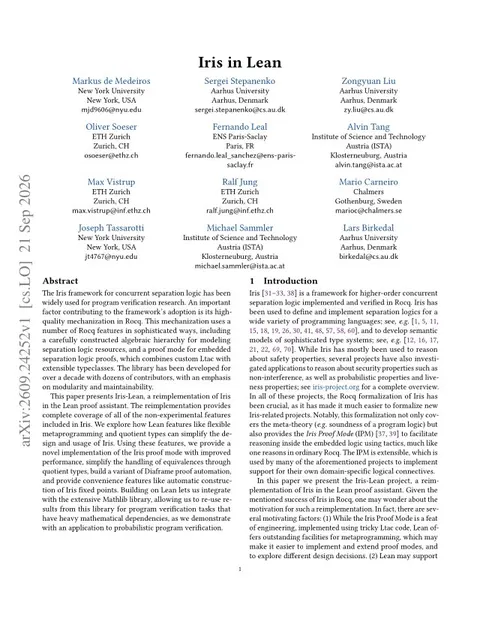
First page of the paper
Image: paperswithlean.com

Checked against: arXiv:2609.24252
Lean core

Leo de Moura prototypes on-demand commutation theorems for state operations

Leo de Moura's Commute repository combines a simproc (a metaprogram that simp calls on matching subterms) with realizable constants, so only the pairs proofs use are ever proved, avoiding a quadratic table of lemmas. A related Lean pull request by Sebastian Ullrich adds Environment.realizationEnvContains.

Checked against: leodemoura/Commutelean4#15237

AI and formalization

Ten Claude Opus 5.5 agents produce a Lean-verified shortest-path algorithm, C-HD

Geby Jaff of Vals AI had 10 Claude Opus 5.5 agents coordinate on a message board; after about 15 hours and 733 messages they proposed C-HD, whose Lean proof (checked with the Lean Comparator tool) establishes a strict asymptotic improvement over n log n for a stated density of edges. The constants are enormous, so no practical speedup is established.

Image: vals.ai

Checked against: vals.ai

Verification

Trail of Bits proves Miden core library arithmetic correct with AI-generated Lean proofs

During an audit of the Miden VM, a zero-knowledge VM with its own assembly language, Trail of Bits had agents build a Lean model of the VM executor, producing 95 correctness proofs covering all binary arithmetic components of the core library. The work identified two subtle bugs that the existing unit test suite did not catch.

Image: blog.trailofbits.com

Checked against: blog.trailofbits.com

Verification

Velvet 2.0 released, and Ilya Sergey publishes Vermilion, a Lean backend for Verus

Velvet 2.0 is now based on Lean's most recent verification machinery, is easier to set up and 10x faster, adding exception specs, ghost state and named proof goals. Vermilion, an experimental Lean 4 backend for the Verus Rust verifier, turns each obligation into a Lean theorem checked by the Lean kernel.

Checked against: LinkedIn postilyasergey/vermilion

Lean core

Kim Morrison proposes supply-chain audits for Mathlib dependency updates

A Mathlib pull request by Kim Morrison adds a supply-chain audit step to the hourly update_dependencies.yml workflow, posting diffs, high-risk files touched and suspicious added lines for each changed dependency. The diffs come from paranoid-lake-update, which uses bare clones and git only, so nothing from upstream is executed.

Checked against: mathlib4#43911

Verification

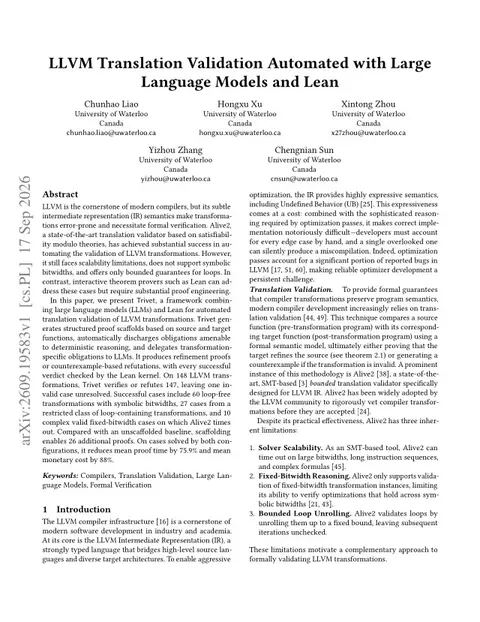
Trivet combines LLMs and Lean to validate LLVM compiler transformations

Chunhao Liao, Hongxu Xu, Xintong Zhou, Yizhou Zhang and Chengnian Sun present Trivet, which verifies or refutes 147 of 148 LLVM transformations, including 60 loop-free transformations with symbolic bitwidths and 27 loop-containing cases. Every successful verdict is checked by the Lean kernel.

First page of the paper
Image: paperswithlean.com

Checked against: arXiv:2609.19583

Lean core

Lake gains a samply profiling command, copied path dependencies, and separate codegen

Kim Morrison's lake samply command records a CPU profile of a Lean executable and serves it to Firefox Profiler, and Mac Malone added a copy option for path dependencies and split leanir code generation into a separate Lake job. Mac Malone also published Nerodia, a work-in-progress library for Lean/Python FFI inspired by PyO3.

Checked against: lean4#12545lean4#15142lean4#14906lean4#15231nerodia.lean-lang.org

Lean core

Lean publishes hex, an aggregator for verified computational algebra libraries

The leanprover/hex repository bundles the released hex libraries for verified computational algebra in Lean 4, including LLL lattice reduction, integer polynomial factorization, graph canonical labelling via a formalization of nauty, and algebraic numbers. Each computational library is Mathlib-free, with Mathlib correspondence proofs in separate theory libraries.

Checked against: leanprover/hex

Lean core

Lean FRO publishes con-ron, a Rust port of the con-leche checker

con-ron ports con-leche, an external Lean checker with a formal consistency proof, to Rust. It was written by AI under supervision from Joachim Breitner, and its Rust code is proven (partially) correct via an Aeneas-generated model, so checking a proof with both tools guards against compiler or runtime bugs.

Checked against: leanprover/con-ron

Lean core

Wojciech Nawrocki adds an HTML type and HTML-like syntax to Lean

Two merged pull requests add Lean.Data.Html, a type of HTML forests aimed primarily at authoring HTML, with a renderer that produces a String, plus HTML-like syntax with an elaborator into that type. Companion downstream-lean4 pull requests adopt the type and syntax throughout supported packages.

Checked against: lean4#14935lean4#15002

Papers and events

XTX Markets grants $10mn each to Lean FRO and the Mathlib Initiative

XTX Markets announced $10mn to Lean FRO, a focused research organisation run by Convergent Research, and $10mn to the Mathlib Initiative, each covering core operating costs to 2030. XTX Markets says Lean provided the verification layer in the auto-formalisation of Fermat's Last Theorem.

Image: xtxmarkets.com

Checked against: xtxmarkets.com

Lean core

Lean FRO and SAIR Foundation launch Stage 1 of Lean Kernel Challenge

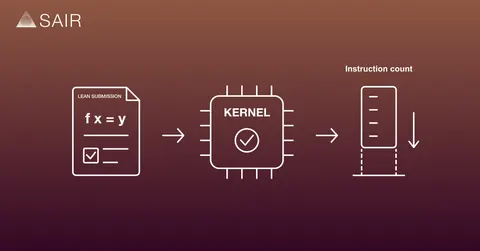
The multi-stage competition seeks faster algorithms for verified computation (using the Lean kernel to check computational results in a proof) across eight problems, including Fibonacci, prime counting, Rule 110, and SHA-256. Entrants prove each algorithm matches its specification; submissions close November 20, 2026.

Lean Kernel Challenge submission verification and instruction count workflow
Image: competition.sair.foundation

Checked against: terrytao.wordpress.comcompetition.sair.foundation

Lean core

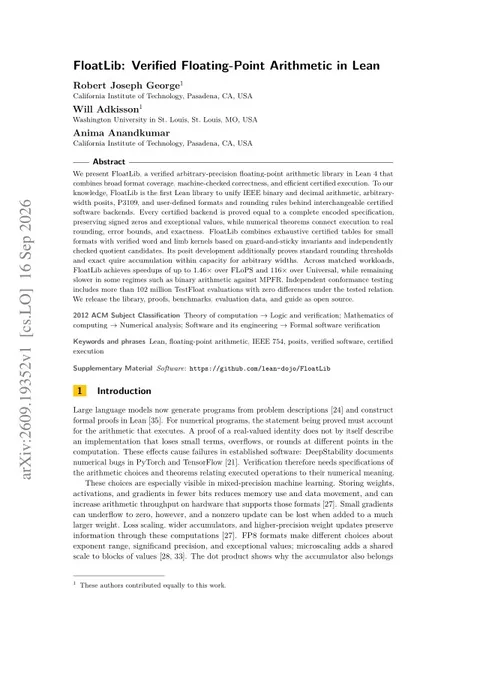
Robert Joseph George, Will Adkisson, Anima Anandkumar present FloatLib for Lean 4

FloatLib is a verified arbitrary-precision floating-point arithmetic library in Lean 4 that unifies IEEE binary and decimal arithmetic, arbitrary-width posits, P3109, and user-defined formats and rounding rules. Every certified backend is proved equal to a complete encoded specification, and the library, proofs, and benchmarks are released as open source.

First page of the paper
Image: paperswithlean.com

Checked against: arXiv:2609.19352

Lean core

Lean 4.34.0 fixes three kernel soundness issues found with AI testing

Lean 4.34.0, released 2026-09-14, fixes three soundness issues found with AI adversarial testing and adds defensive kernel checks. bv_decide gets integrated with sym and grind interactive modes and is up to six times faster, linters can carry state across commands, and lake lint gains a --code-quality mode emitting machine-readable JSON.

Checked against: v4.34.0 release notes

Verification

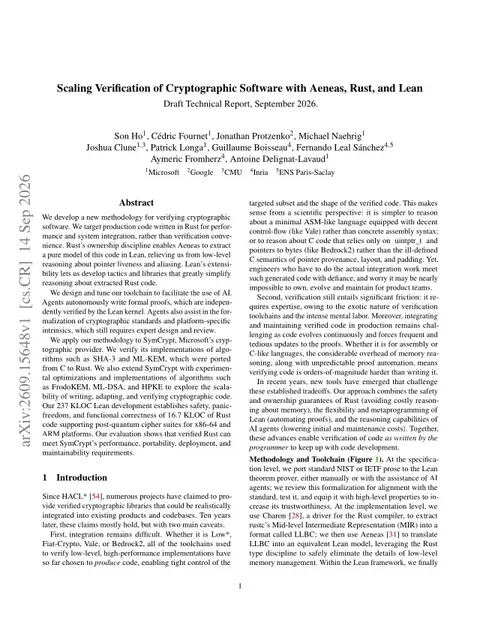
Son Ho and colleagues verify Rust code in Microsoft's SymCrypt with Lean

Using Aeneas, which extracts a pure model of Rust code in Lean, a 237 KLOC Lean development establishes safety, panic-freedom, and functional correctness of 16.7 KLOC of Rust, including SHA-3 and ML-KEM ported from C. AI agents autonomously write proofs, which the Lean kernel independently verifies.

First page of the paper
Image: paperswithlean.com

Checked against: arXiv:2609.15648

Papers and events

Greg Brockman says AI makes formally verifying all software possible

Greg Brockman says OpenAI pointed Astra at its own systems until it ran out of vulnerabilities to find, putting 25% of its production engineers on defense. Greg Brockman added: "There are ideas, for example, formally verifying all of software, that are possible with AI."

Image: x.com/a16z

Checked against: @a16z on X

Verification

Certora proves zlib's inflate_table memory-safe and terminating in Lean

In under two weeks, Certora built an experimental C-to-Lean pipeline and proved that the Clight (CompCert's C intermediate representation) model of zlib's 266-line inflate_table function is memory-safe and terminating. The proof, around 20,000 lines of Lean, was written almost entirely by LLMs, and the Lean kernel checked every step.

Formally Verifying zlib Memory Safety with Lean | Certora
Image: certora.com

Checked against: certora.com

Lean core

Joachim Breitner announces con-leche, a Lean checker proven consistent

con-leche is an external checker for Lean, proven in Lean never to accept a proof of False, implemented and proven by Claude (Fable and Opus) under heavy supervision by Joachim Breitner at the Lean FRO. On the FLT proof by Anthropic, it accepted 1,044,222 declarations in 2 h 22 min wall time.

Checked against: leanprover/con-lecheleanprover.zulipchat.com

AI and formalization

OpenAI announces Lean-checked singularity in the 3D Navier-Stokes equations

OpenAI said 10,000 autonomous AI agents found a singularity in the Navier-Stokes equations in three dimensions, with the result formally checked in Lean. Hours earlier, Tristan Buckmaster at New York University and Levent Alpöge at Anthropic reported Lean-verified proofs for three related results, including one for the Euler equations.

Image: quantamagazine.org

Checked against: quantamagazine.orgblog.computationalcomplexity.org

Lean core

Sebastian Ullrich logs build optimizations for Anthropic's Lean proof of Fermat's Last Theorem

On a 1,000-module slice, adopting the module system and import minimization cut task-clock to 3,268 s (down 63.1%) and wall-clock to 140 s (down 86.3%). Sebastian Ullrich also released the proof as a single 1.01 GiB .olean download that can be run through lean4export for external checkers.

Optimizing Anthropic's Lean proof of Fermat's Last Theorem - HackMD
Image: hackmd.io

Checked against: hackmd.iofermats-last-theorem export

Lean core

Kim Morrison opens Mathlib PRs for certified root counting and sum-of-squares

Kim Morrison opened a Mathlib pull request adding real_root_count, which checks an untrusted Sturm chain from Hex and shrinks the Abel–Ruffini archive file from 175 to 127 lines. A second pull request adds the leanprover/sos sum-of-squares tactic, where CSDP serves as a search oracle outside the trusted base.

Checked against: mathlib4#43512mathlib4#42336

AI and formalization

Anthropic's Claude formalizes a complete proof of Fermat's Last Theorem in Lean

Working largely autonomously over 11 days, Claude wrote 13 million lines of Lean (over 5x the size of Mathlib, the principal community library) and proved 29,500 intermediate theorems. Kevin Buzzard compiled the code and ran comparator on it, and the full proof is on GitHub with a written walk-through.

Mathematical image reminiscent of elliptical curves
Image: anthropic.com

Checked against: anthropic.comxenaproject.wordpress.comanthropics/fermats-last-theoremnature.com

More news